
If you’ve read our guide to Calving Season in the Serengeti, you already know where the story begins.
Thousands of newborn wildebeest take their first steps across Tanzania’s southern plains. Predators wait patiently. Survival begins within minutes of birth.
But that is only the first chapter.
The moment those calves are strong enough to run, one of nature’s greatest journeys begins.
The herds start moving.
Not because they choose to.
Because they must.
Fresh grass is disappearing. Rain clouds are gathering elsewhere. Ancient instincts take over.
And so begins the Great Wildebeest Migration Safari—a year-round journey involving more than 1.5 million wildebeest, hundreds of thousands of zebras, and countless predators moving through the vast landscapes of Tanzania and Kenya.
👉 Before continuing, read our guide to Calving Season: Where the Great Migration Begins.
The Migration Is Not an Event—It’s a Story
Many travelers imagine the Great Migration as a single dramatic river crossing.
In reality, the migration is a continuous cycle that unfolds throughout the year.
Calving season is the opening chapter.
The migration itself is the journey.
Every movement is driven by rainfall, grazing conditions, and survival.
Unlike humans, these animals do not carry maps.
Yet somehow, year after year, they follow the same ancient route across the Serengeti-Mara ecosystem.
This remarkable ecosystem is jointly protected by:
Together, they form one of the world’s most important wildlife corridors.
Chapter Two: The Long Walk North
April to June
The lush southern plains begin to dry.
The newborn calves that struggled to stand just weeks ago are now running with the herd.
Millions of animals begin moving northwest through the Serengeti.
The migration stretches for kilometers across the horizon.
Dust rises into the air.
Predators follow closely behind.
For wildlife photographers, this period offers incredible opportunities to capture:
- Endless wildlife columns
- Dramatic storm clouds
- Predator interactions
- Golden-hour landscapes
Unlike the river crossing season, visitor numbers are often lower, allowing for more intimate safari experiences.
Chapter Three: The River of Decisions
July to October
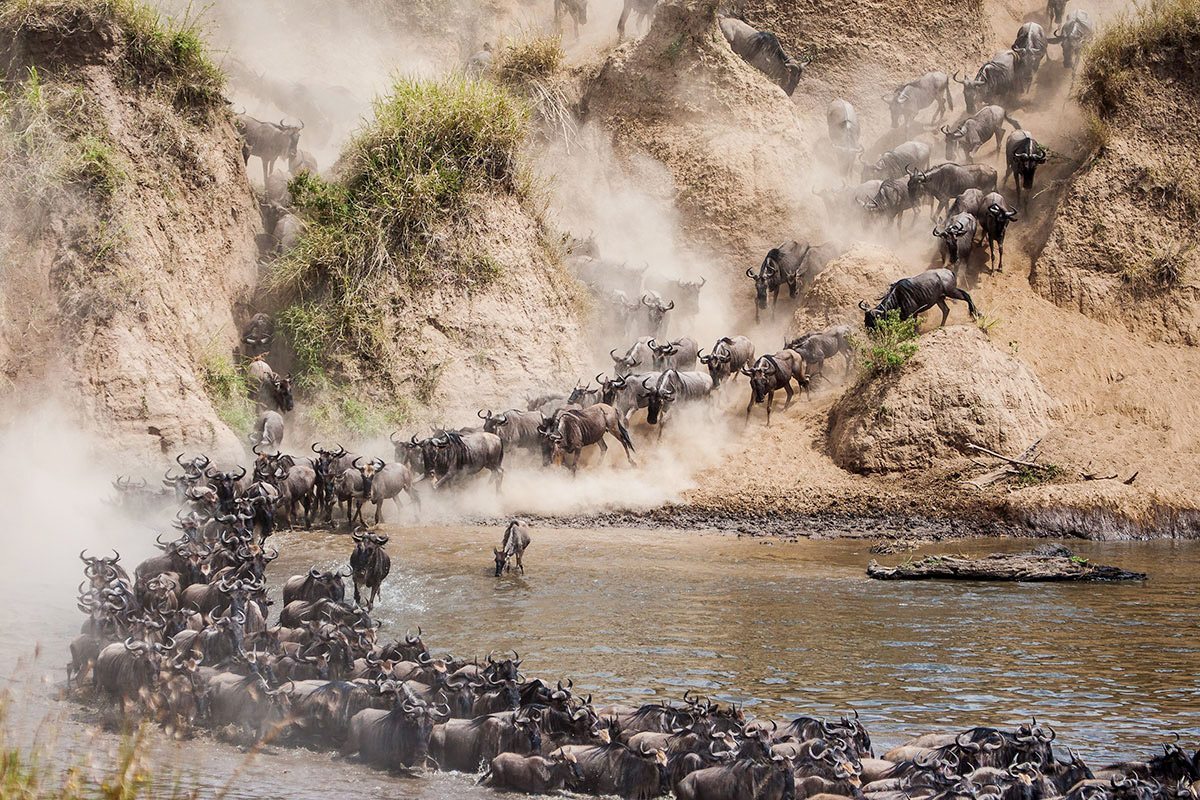
Eventually, the herds arrive at the obstacle every traveler dreams about witnessing.
The Mara River.
This is where the migration transforms from a journey into a spectacle.
Thousands gather on the riverbanks.
They wait.
They hesitate.
They retreat.
No one knows what finally triggers the crossing.
But when it happens, it happens fast.
The herd surges forward.
Water erupts.
Crocodiles strike.
The current pulls.
And somehow, most survive.
The Mara River crossings have earned global recognition as one of Africa’s most extraordinary wildlife events.
According to the World Wildlife Fund (WWF), the Serengeti-Mara ecosystem hosts the largest remaining large mammal migration on Earth.
Why Every River Crossing Is Different
One of the most fascinating things about the migration is its unpredictability.
A crossing may happen:
- At sunrise
- At noon
- At sunset
- Several times a day
- Not at all
Some herds wait for hours.
Others wait for days.
This uncertainty is what makes witnessing a crossing so exciting.
There is no script.
No schedule.
Only nature.
The Hidden Stars of the Migration
While wildebeest often steal the spotlight, they are not alone.
The migration includes:
Zebras
Often the first to identify fresh grazing.
Thomson’s Gazelles
Fast-moving companions that follow the larger herds.
Lions
The Maasai Mara’s lion population thrives during migration season.
Cheetahs
Open grasslands create ideal hunting conditions.
Nile Crocodiles
Some of Africa’s largest crocodiles wait in the Mara River year-round.
Learn more about Kenya’s wildlife through the Kenya Wildlife Service.
Why the Great Migration Is One of the Best Wildlife Photography Experiences in Africa
Few wildlife events offer such a variety of photographic opportunities.
Photographers can capture:
River crossings
Predator hunts
Dust-filled landscapes
Dramatic weather
Intimate wildlife behavior
Golden African sunsets
This is why migration season consistently attracts photographers from around the world.
When Is the Best Time for a Great Wildebeest Migration Safari?
January – March
Calving season in Southern Serengeti.
April – June
Movement through Central and Western Serengeti.
July – October
Mara River crossings and Maasai Mara wildlife action.
November – December
Return migration southward.
Each season tells a different part of the story.
From Birth to Survival: The Complete Migration Story
Think back to that newborn calf from our Calving Season blog.
The one struggling to stand.
The one taking its first uncertain steps.
Months later, that same calf may be standing on the banks of the Mara River.
Facing crocodiles.
Facing currents.
Facing the next challenge in its journey.
That is what makes the Great Migration so extraordinary.
It is not one event.
It is a continuous story of life, survival, resilience, and instinct.
And every chapter is worth witnessing.
Experience the Great Migration With Aardwolf Africa Safaris
At Aardwolf Africa Safaris, we carefully design migration safaris around wildlife movement patterns, seasonal conditions, and the best photographic opportunities.
Whether you’re interested in:
- Calving Season Safaris
- Mara River Crossings
- Wildlife Photography Expeditions
- Luxury Maasai Mara Safaris
our experienced guides ensure you are in the right place at the right time.
Explore our:
- 4 Days Maasai Mara Lodge Safari
- 6 Days Kenya Finest Luxury Safari
- 9 Day Exclusive Kenya Safari
- 11 Days Explore Kenya Safari
for unforgettable migration experiences.
Conclusion
Every migration begins with a birth.
Every river crossing begins with a single step.
From the lush calving grounds of Southern Serengeti to the dramatic waters of the Mara River, the Great Migration remains one of the most powerful wildlife stories on Earth.
It reminds us that survival is a journey, not a destination.
And for travelers fortunate enough to witness it, it becomes a story they carry forever.
Internal Links
- Calving Season: Where the Great Migration Begins
- Maasai Mara Safari Packages
- Kenya Photography Safaris
- Luxury Kenya Safari Packages
- 11 Days Explore Kenya Safari
- 6 Days Kenya Finest Luxury Safari
Recommended External Links
- Serengeti National Park Official Site
- Ngorongoro Conservation Area Authority
- Kenya Wildlife Service
- World Wildlife Fund (WWF) Wildlife Migration Resources
Start your journey into the Heart of the Wild today.
Explore our Kenya and Tanzania safari packages or contact our team to create your perfect migration adventure.

